 Skip to content
How do you keep your business running when your CFO suddenly resigns? What happens when your controller takes medical leave just before year-end? Why do smart Miami business owners plan for financial leadership gaps before they happen?
These aren’t theoretical questions. They’re real scenarios that happen every single day to businesses across Miami, from Brickell high-rises to Doral manufacturing facilities. And how you handle these moments of financial leadership transition often determines whether your business thrives, survives, or struggles through what should be manageable changes.
This is where interim management finance in Miami FL becomes not just helpful—but essential.
What Is Interim Management Finance and Why Does It Matter in Miami?

Understanding Interim Finance Management
Interim management finance in Miami FL refers to experienced financial executives who step into leadership roles on a temporary basis during transitions, crises, or transformation periods. Unlike permanent hires or fractional CFOs working part-time across multiple clients, interim finance managers provide full-time, dedicated leadership for defined periods—typically three to eighteen months.
Think of interim finance management as the financial equivalent of a relief pitcher in baseball. When your starter goes down, you don’t leave the position empty or ask someone unqualified to fill in. You bring in a seasoned professional who can step into the role immediately and perform at a high level until you’re ready for a permanent solution.
Why Miami Businesses Face Unique Interim Finance Challenges
Miami’s business landscape creates specific circumstances where interim management finance becomes particularly critical:
Rapid growth environments: Miami’s booming economy means businesses scale quickly, often outgrowing financial leadership before recognizing the need for upgrades.
International business complexity: As a gateway to Latin America, Miami companies frequently navigate multi-currency operations, international compliance, and cross-border transactions requiring sophisticated financial expertise.
Seasonal business fluctuations: Tourism, hospitality, and real estate sectors experience dramatic seasonal variations demanding flexible financial leadership that can scale with business cycles.
Competitive talent market: Miami’s growing reputation as a business hub means fierce competition for top financial talent, making permanent hires challenging and time-consuming.
Private equity and M&A activity: Significant transaction activity in Miami creates periods of intense financial leadership needs during due diligence, integration, or restructuring.
How to Know When Your Miami Business Needs Interim Management Finance

Scenario 1: How to Handle Sudden Executive Departure
The situation: Your CFO accepts a position at another company, giving two weeks notice. Or worse—they’re terminated for performance issues or ethical violations requiring immediate removal.
Why interim management finance solves this:
You need someone who can:
- Maintain financial operations continuity from day one
- Preserve institutional knowledge before it walks out the door
- Provide stability to your finance team during uncertainty
- Maintain stakeholder confidence (investors, lenders, board members)
- Buy time for thorough permanent CFO search without pressure hiring
Real Miami example: A Brickell-based fintech company lost their CFO unexpectedly just as they were preparing for Series B fundraising. Rather than rushing a permanent hire or asking their controller to stretch beyond capabilities, they brought in interim management finance leadership. The interim CFO maintained fundraising momentum, prepared investor materials, managed due diligence, and closed the $8M round successfully. The company then had breathing room to conduct a proper CFO search, ultimately hiring someone perfect for their next growth stage.
How to implement interim finance management in this scenario:
- Move immediately (within 24-48 hours of departure announcement)
- Define the scope clearly: What must the interim manager accomplish? What decisions can they make independently?
- Brief them comprehensively: Provide access to all financial systems, stakeholder relationships, and strategic context
- Set clear timeline: When do you need a permanent replacement? What milestones must occur before then?
- Communicate transparently: Tell your team, board, and key stakeholders about the transition plan
Scenario 2: How to Navigate Rapid Growth Financial Demands
The situation: Your business has grown from $5M to $20M in revenue over two years. Your bookkeeper-turned-controller is overwhelmed. You need CFO-level leadership but aren’t sure you can sustain a $200K+ permanent hire yet.
Why interim management finance solves this:
Interim management finance in Miami FL provides:
- Immediate financial sophistication matching your current complexity
- Assessment of what financial leadership you actually need long-term
- Implementation of systems and processes scalable for continued growth
- Team development preparing internal staff for higher-level responsibilities
- Flexibility to scale back if growth slows or convert to permanent if sustainable
Real Miami example: A Miami Beach hospitality group expanded from three to eight properties in eighteen months. Their part-time bookkeeper couldn’t keep up, but they weren’t confident revenue would sustain permanently at new levels. Interim finance management came in for twelve months, implemented property-level financial reporting, centralized purchasing, optimized cash management, and built financial forecasting models. Revenue sustained and grew, and the interim manager helped recruit and onboard their first permanent CFO before transitioning out.
How to implement interim finance management for growth:
- Assess your current financial infrastructure gaps: What’s breaking? What’s missing entirely?
- Define the transformation scope: What systems, processes, and capabilities need building?
- Set success metrics: How will you know the interim engagement succeeded?
- Involve the interim manager in permanent search planning: They understand what you’ll need long-term
- Document everything: Ensure knowledge transfer enables sustainability after interim period
Scenario 3: How to Manage Transaction-Related Finance Needs
The situation: You’re acquiring another company, being acquired, going through a merger, divesting a division, or restructuring after private equity investment.
Why interim management finance solves this:
Transactions create temporary spikes in financial leadership demands:
- Due diligence coordination and management
- Integration planning and execution
- Synergy identification and tracking
- Restructuring and process harmonization
- Stakeholder communication during disruption
Your existing finance team—even if strong—typically lacks bandwidth for both ongoing operations and transaction demands. Permanent hires don’t make sense for temporary needs.
Real Miami example: A Coral Gables professional services firm acquired a complementary business doubling their size. Their controller was excellent at running steady-state operations but had never managed an acquisition integration. Interim management finance came in specifically for the integration period (nine months), coordinated financial systems consolidation, standardized processes across entities, and managed the transition. Post-integration, the controller successfully resumed leadership of unified operations with upgraded systems and processes.
How to implement interim finance management for transactions:
- Bring them in pre-transaction: Interim managers add most value participating in due diligence, not just post-close
- Define clear roles: How does interim manager interface with existing finance leadership and transaction advisors?
- Set integration milestones: What needs accomplishing by 30/60/90/180 days post-close?
- Manage stakeholder expectations: Communicate the interim nature and transition plan clearly
- Build sustainability: Ensure processes implemented can continue after interim manager departs
Scenario 4: How to Address Financial Performance Crisis
The situation: Your business is losing money, burning cash, facing covenant violations, or experiencing financial distress requiring immediate intervention.
Why interim management finance solves this:
Turnaround situations demand:
- Objective assessment unclouded by organizational politics or history
- Immediate credibility with lenders and stakeholders
- Rapid decision-making and implementation
- Financial expertise specific to distressed situations
- Willingness to make difficult decisions existing leadership might avoid
Real Miami example: A Doral manufacturing company faced potential loan default due to declining margins and cash burn. Their long-tenured CFO had been with the company fifteen years but lacked turnaround experience. The board brought in turnaround-specialist interim management finance leadership who immediately implemented cash preservation measures, renegotiated vendor terms, restructured banking relationships, and identified operational improvements. The company returned to profitability within six months. The original CFO then resumed leadership of stabilized operations.
How to implement interim finance management in crisis:
- Act with urgency: Distressed situations deteriorate quickly without intervention
- Grant appropriate authority: Interim managers need decision-making power to act decisively
- Communicate the mandate: Everyone must understand the interim manager’s authority and objectives
- Focus on stabilization first: Solve the bleeding before optimization
- Plan the transition: How and when does permanent leadership resume?
Scenario 5: How to Handle Extended Medical or Personal Leave
The situation: Your CFO needs medical leave for surgery and recovery, family leave for personal matters, or extended time off for other legitimate reasons.
Why interim management finance solves this:
Unlike unexpected departures, planned leaves allow smooth transitions:
- Seamless handoff from departing executive to interim manager
- Defined timeline with clear return expectations
- Maintenance of relationships and institutional knowledge
- Development opportunity for internal team members
- Reduced pressure on returning executive during recovery
Real Miami example: A Wynwood technology company’s CFO needed a three-month medical leave. Rather than overburden their controller or leave the role understaffed, they engaged interim management finance in Miami FL for the specific period. The interim CFO maintained all board and investor relationships, managed a banking relationship renewal, and mentored the controller. When the permanent CFO returned, operations had run smoothly and they’d actually implemented improvements the interim manager identified.
How to implement interim finance management for leaves:
- Plan the transition early: Start interim search when leave becomes known, not when it begins
- Facilitate comprehensive handoff: Departing executive should brief interim manager thoroughly
- Maintain connection: If appropriate, keep departing executive minimally involved in critical decisions
- Prepare for return: Plan reverse handoff ensuring smooth reintegration
- Capture improvements: Document beneficial changes interim period revealed
Why Interim Management Finance Delivers Superior Results Compared to Alternatives

Why Not Just Promote from Within?
The temptation: Promote your controller or senior accountant to acting CFO during the gap.
Why this often fails:
- Skill gap: Transaction processing skills differ fundamentally from strategic financial leadership
- Overwhelm risk: Adding CFO responsibilities on top of existing duties creates burnout and errors
- Limited perspective: Internal promotions lack fresh eyes identifying improvement opportunities
- Stakeholder confidence: Investors and lenders may question whether interim internal leadership provides adequate sophistication
- Permanent damage: Failed interim leadership can derail promising careers and create lasting organizational dysfunction
When internal promotion works: For very small organizations where the controller genuinely has CFO capabilities and you only need time for external search.
Why interim management finance is better: Brings immediate CFO-level expertise without overburdening internal team, provides objective assessment, and develops internal talent through mentorship rather than trial by fire.
Why Not Use Your Accounting Firm?
The temptation: Ask your external accountants to provide interim CFO services since they know your business.
Why this creates problems:
- Conflict of interest: The same firm shouldn’t provide both accounting/audit services and management functions
- Different skill sets: Tax accountants and auditors aren’t necessarily strategic CFOs
- Limited availability: Accounting firms operate on client engagement models limiting dedicated time
- Temporary relationship: Accounting firms want ongoing audit/tax relationships, not temporary management roles
- Independence concerns: Regulators and lenders question the independence of accountants serving dual roles
When accounting firm involvement works: For very specific technical matters like complex accounting treatment or tax strategy.
Why interim management finance is better: Provides dedicated, full-time leadership without conflicts, brings management expertise rather than just technical accounting knowledge, and maintains proper separation between internal management and external advisors.
Why Not Just Hire Faster?
The temptation: Rush your permanent CFO search to fill the gap quickly.
Why this backfires:
- Bad hires cost far more than delays: Wrong CFO hire can set organizations back years and cost hundreds of thousands
- Pressure hiring reduces quality: Rushed searches miss better candidates with longer notice periods
- Incomplete assessment: Proper executive search takes 3-6 months for thorough evaluation
- Desperation shows: Candidates and recruiters sense urgency and may press for unfavorable terms
- Mismatch risk: Quick hires often prove poor fits requiring expensive do-overs
When faster hiring works: In rare cases where you have a known, pre-vetted candidate immediately available.
Why interim management finance is better: Eliminates pressure to rush permanent hire, allows thorough search process, and provides stability enabling confident long-term decision-making.
How to Select the Right Interim Management Finance Provider in Miami

Critical Qualifications to Verify
Actual CFO/Controller Experience
Your interim finance manager should have actually held CFO or senior controller positions in real companies—not just accountants calling themselves interim CFOs.
How to verify:
- Request detailed work history with specific titles and companies
- Ask about the size and complexity of organizations they’ve led
- Inquire about specific accomplishments and measurable outcomes
- Check LinkedIn profiles for consistency with claims
- Request references from CEOs and board members they’ve served
Industry-Relevant Background
While financial fundamentals apply universally, industry-specific knowledge accelerates value delivery.
How to assess:
- Ask about experience in your specific industry
- Inquire about related industries sharing similar financial characteristics
- Discuss industry-specific challenges to gauge understanding depth
- Request examples of industry-relevant accomplishments
Miami Market Knowledge
Interim management finance in Miami FL delivers enhanced value through local market understanding:
- Local lender relationships and banking landscape knowledge
- Understanding of Miami’s business environment and economic drivers
- Familiarity with local professional service providers (attorneys, consultants, recruiters)
- Cultural fluency in Miami’s diverse, international business community
- Geographic accessibility for in-person presence when needed
How to evaluate:
- Ask about other Miami engagements (respecting confidentiality)
- Discuss Miami-specific market dynamics to assess understanding depth
- Inquire about local professional networks
- Verify physical presence enabling responsive local support
Essential Capabilities to Confirm
Immediate Impact Ability
Interim managers must deliver value from day one without extended ramp-up periods.
How to confirm:
- Ask about their typical onboarding process and timeline to productivity
- Discuss how they quickly assess situations and prioritize actions
- Request examples of quick wins in previous interim roles
- Inquire about their approach to learning new businesses rapidly
Stakeholder Management Skills
Interim finance managers interact with boards, investors, lenders, and teams requiring excellent communication and relationship skills.
How to assess:
- Discuss their experience managing board and investor relationships
- Ask about challenging stakeholder situations they’ve navigated
- Evaluate communication style during interviews
- Request references specifically addressing stakeholder management
Change Management Experience
Interim engagements inherently involve change requiring change leadership capabilities.
How to evaluate:
- Ask about major transformations they’ve led
- Discuss their approach to organizational change management
- Inquire about resistance they’ve encountered and how they addressed it
- Request examples of successful change implementation
Systems and Process Implementation
Interim managers often implement or upgrade financial systems and processes.
How to confirm:
- Discuss their experience with relevant financial software platforms
- Ask about systems implementations they’ve led
- Inquire about their approach to process design and documentation
- Request examples of sustainable improvements they’ve implemented
Red Flags to Avoid
Lack of Recent Operating Experience
Avoid interim managers whose only recent experience is interim/consulting work. The best interim managers alternate between permanent roles and interim engagements, maintaining current operating expertise.
Inability to Provide Specific Examples
Generic answers about “typical” approaches rather than specific examples from actual interim engagements suggest limited relevant experience.
Poor Cultural Fit
Even for temporary engagements, cultural alignment matters. Interim managers must work effectively within your organizational culture rather than against it.
Unclear Engagement Structure
Reputable interim finance providers clearly articulate engagement terms, responsibilities, success criteria, and transition planning from the outset.
Conflicts of Interest
Verify the interim manager has no conflicts that could compromise objectivity or create ethical issues.
How Gaudet and Associates Delivers Interim Management Finance in Miami FL
When Miami businesses face financial leadership transitions, Gaudet and Associates provides interim management finance in Miami FL specifically designed for the unique challenges of South Florida’s dynamic business environment.
Our Interim Finance Management Approach
Rapid Deployment
We understand that interim needs often arise with little warning. Our interim management finance professionals can begin engagements within days, not weeks:
- Initial assessment: Within 48 hours of engagement, we conduct comprehensive situation assessment
- Immediate stabilization: Critical operations continue uninterrupted while we get up to speed
- Quick wins identification: We prioritize high-impact actions delivering immediate value
- 90-day plan development: Within first two weeks, we develop clear roadmap for the interim period
Customized Solutions
Every interim engagement differs based on circumstances, objectives, and organizational context. Our interim management finance in Miami FL services customize to your specific situation:
- Crisis stabilization: Immediate intervention for distressed situations requiring rapid financial leadership
- Growth management: Scaling financial infrastructure and capabilities for rapidly expanding businesses
- Transaction support: Due diligence, integration, or restructuring for M&A activity
- Leadership transition: Seamless continuity during planned or unplanned executive departures
- Transformation projects: Implementing new systems, processes, or organizational structures
Comprehensive Capabilities
Our interim finance managers bring complete CFO-level capabilities:
- Strategic financial planning: Developing financial strategies aligned with business objectives
- Cash flow management: Ensuring adequate liquidity through transition periods
- Financial reporting: Maintaining high-quality reporting to all stakeholders
- Stakeholder relations: Managing board, investor, and lender communications
- Team leadership: Providing direction and development for finance teams
- Systems implementation: Upgrading financial infrastructure and processes
- Compliance oversight: Ensuring regulatory and contractual compliance
- Special projects: Leading specific initiatives like fundraising, restructuring, or refinancing
Why Miami Businesses Choose Gaudet and Associates for Interim Management Finance
Deep Miami Market Experience
Our team understands Miami’s unique business environment from years serving companies across Brickell, Coral Gables, Miami Beach, Doral, Wynwood, Kendall, and throughout South Florida. This local expertise informs every aspect of our interim management finance delivery:
- Knowledge of local lenders and their lending appetites
- Understanding of Miami’s industry dynamics and economic drivers
- Relationships with local professional service providers
- Cultural fluency in Miami’s diverse, international business community
- Geographic presence enabling responsive in-person support
Industry Expertise Across Miami’s Key Sectors
Our interim finance managers bring specialized experience across Miami’s core industries:
- Technology and SaaS: Understanding venture capital expectations and growth company financial management
- Real estate development: Experience with project financing, construction accounting, and complex capital structures
- Healthcare practices: Knowledge of medical billing, insurance contracting, and practice management
- Hospitality and restaurants: Understanding of food and beverage operations, seasonality, and multi-location management
- Manufacturing and distribution: Experience with inventory management, cost accounting, and supply chain finance
- Professional services: Understanding of partnership structures, billing, and utilization management
- International trade: Experience with multi-currency operations, customs, and cross-border transactions
Integrated Service Offerings
Unlike standalone interim providers, Gaudet and Associates offers comprehensive financial services enabling seamless integration:
- Fractional CFO services: Transitioning from interim to ongoing part-time CFO support when appropriate
- Financial reporting services: Implementing robust reporting infrastructure during interim period
- Governance risk & compliance: Addressing compliance issues or implementing GRC programs
- Permanent placement support: Assisting with recruitment and onboarding of permanent finance leadership
This integration means solutions implemented during interim periods continue delivering value long after the engagement concludes.
Proven Track Record
Our interim management finance engagements consistently deliver measurable results:
- Successful transitions: 100% of interim engagements maintain operational continuity without disruption
- Stakeholder confidence: Zero instances of lender or investor concerns during interim periods
- System implementations: Average 40% reduction in month-end close time through process improvements
- Team development: Finance team capabilities consistently strengthened through interim leadership
- Permanent placement: When desired, successful permanent CFO recruitment and onboarding
Real Results from Miami Interim Finance Engagements
Brickell Technology Company – Unexpected CFO Departure
Challenge: CFO resigned with minimal notice during Series B preparation
Interim solution: Full-time interim CFO for six months
Results:
- Maintained fundraising timeline without delays
- Successfully closed $8.3M Series B round
- Prepared investor materials and managed due diligence
- Recruited and onboarded permanent CFO
- Implemented financial planning platform used by permanent CFO
Miami Beach Hospitality Group – Rapid Growth
Challenge: Expanded from 3 to 8 properties in 18 months, overwhelmed existing finance team
Interim solution: Interim CFO for twelve months
Results:
- Implemented property-level financial reporting providing profitability visibility
- Centralized purchasing reducing costs 15%
- Developed cash forecasting preventing liquidity issues
- Built scalable financial infrastructure supporting continued growth
- Recruited permanent CFO and facilitated smooth transition
Coral Gables Professional Services – Acquisition Integration
Challenge: Acquired complementary firm doubling size, controller lacked M&A integration experience
Interim solution: Interim finance director for nine-month integration period
Results:
- Consolidated financial systems across entities
- Standardized processes enabling consistent reporting
- Identified $200K in annual synergies through combined operations
- Trained existing controller on integrated operations
- Documented processes enabling sustainable ongoing management
Doral Manufacturing – Financial Distress
Challenge: Declining margins, cash burn, potential loan default
Interim solution: Turnaround-specialist interim CFO for nine months
Results:
- Implemented immediate cash preservation measures
- Renegotiated vendor terms improving working capital $300K
- Restructured banking relationship avoiding default
- Identified operational improvements restoring profitability
- Transitioned to permanent CFO leading stabilized company
How to Engage Interim Management Finance Services: Step-by-Step Process
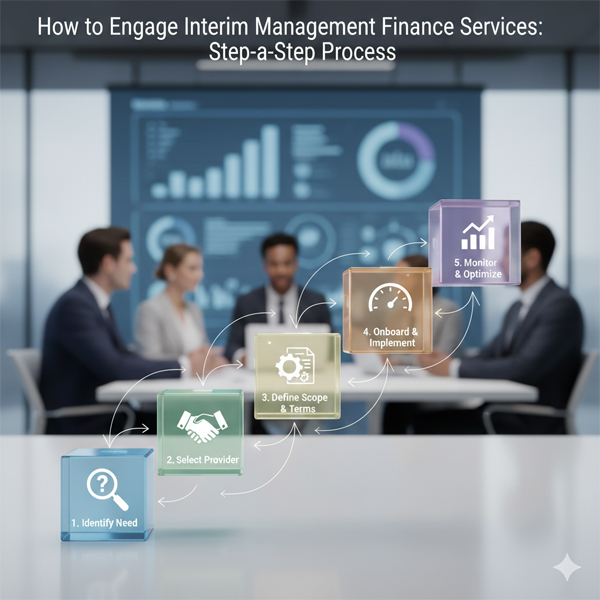
Step 1: Recognize the Need Immediately
Don’t wait. The moment you identify a financial leadership gap—whether sudden departure, planned leave, growth overwhelm, or crisis—begin interim planning.
Common delays that cost businesses:
- “We’ll make do temporarily” – Leading to errors, missed opportunities, and stakeholder concerns
- “We’ll just hire faster” – Resulting in pressure hiring and costly bad hires
- “Our controller can handle it” – Creating burnout and potentially career-damaging failures
Immediate action items:
- Acknowledge the gap honestly
- Assess the timeline (How long until permanent solution?)
- Evaluate interim alternatives
- Contact potential interim providers
Step 2: Define Your Interim Needs Clearly
Before engaging interim providers, clarify:
Scope of responsibilities:
- What decisions can the interim manager make independently?
- What requires CEO/board approval?
- How much authority do they have over existing team?
- What stakeholder relationships will they manage?
Timeline expectations:
- How long do you anticipate needing interim support?
- What milestones must occur before permanent solution?
- How will you know it’s time to transition out?
Success criteria:
- What must the interim manager accomplish?
- What would constitute successful engagement?
- How will you measure performance?
Integration requirements:
- How does interim manager interface with existing team?
- What systems access do they need?
- Where will they work (on-site vs. remote)?
- What communication/reporting rhythms are expected?
Step 3: Evaluate Interim Finance Providers
Key evaluation criteria:
Relevant experience:
- Have they handled similar situations (crisis, growth, transaction, etc.)?
- Do they have industry knowledge applicable to your business?
- Can they provide specific examples and references?
Availability and timeline:
- Can they start when you need them?
- Do they have capacity for full engagement (not splitting attention)?
- How long can they commit if needed?
Chemistry and fit:
- Do they communicate well with your leadership style?
- Will they work effectively within your culture?
- Do stakeholders feel confident in their capabilities?
Practical considerations:
- What’s their fee structure?
- Are there any conflicts of interest?
- What’s included vs. additional costs?
Interview questions to ask:
- “Walk me through a similar interim engagement you’ve handled. What was the situation, your approach, and the outcome?”
- “How do you typically get up to speed in new organizations? What’s your onboarding process?”
- “What would your first 30/60/90 days look like in our situation?”
- “How do you balance maintaining operations with implementing improvements?”
- “Describe a challenging stakeholder situation you navigated as an interim manager.”
- “What happens if the engagement needs extending beyond initial timeline?”
- “How do you approach transitioning out when permanent leadership is in place?”
Step 4: Structure the Engagement Properly
Essential engagement elements:
Clear agreement documenting:
- Scope of work and responsibilities
- Timeline and extension provisions
- Fee structure and payment terms
- Confidentiality and non-compete provisions
- Termination conditions for both parties
- Success criteria and performance expectations
Communication protocols:
- Regular check-ins with CEO/board
- Reporting requirements and formats
- Decision escalation processes
- Stakeholder communication responsibilities
Access and authorities:
- System access provisioning
- Signature authorities
- Team management responsibilities
- Vendor and banking relationship management
Transition planning:
- Knowledge transfer requirements
- Documentation expectations
- Permanent placement involvement (if applicable)
- Post-engagement support availability
Step 5: Onboard Effectively for Immediate Impact
First week priorities:
Information gathering:
- Financial statements and reports review
- Systems and process documentation
- Organization chart and team introductions
- Stakeholder landscape mapping
- Current issues and priorities understanding
Relationship building:
- One-on-ones with finance team members
- Introduction meetings with key stakeholders
- Board/investor communications
- Lender/bank relationship establishment
Quick assessment:
- What’s working well to preserve?
- What’s broken requiring immediate attention?
- What opportunities exist for quick wins?
- What risks need immediate mitigation?
First 30 days deliverables:
- Comprehensive situation assessment
- Quick wins implementation
- 90-day action plan
- Stakeholder confidence building
- Team stabilization
Step 6: Maintain Momentum Throughout Engagement
Ongoing success factors:
Regular communication:
- Weekly updates to CEO
- Monthly board reporting
- Continuous team engagement
- Stakeholder relationship maintenance
Continuous improvement:
- Process enhancements as opportunities identified
- System upgrades where beneficial
- Team development and capability building
- Documentation of all changes
Stakeholder management:
- Board meeting attendance and reporting
- Investor communications and relationship maintenance
- Lender relationship management
- External advisor coordination (auditors, attorneys, etc.)
Flexibility and adaptation:
- Adjust approach based on evolving circumstances
- Extend or shorten timeline as situation dictates
- Modify scope as priorities change
- Balance planned work with emerging needs
Step 7: Plan and Execute Smooth Transition
Transition timing triggers:
- Permanent hire identified and ready to start
- Interim project scope completed
- Business situation stabilized
- Team ready to resume independent operations
- Timeline predetermined at engagement start reached
Effective transition elements:
Knowledge transfer:
- Comprehensive documentation of all changes implemented
- Process and procedure updates
- System access and training
- Relationship introductions and handoffs
- Pending items and future recommendations
Permanent leadership onboarding:
- Interim manager participation in new hire onboarding
- Transition period overlap (typically 2-4 weeks)
- Introduction to key stakeholders
- System and process training
- Strategic context transfer
Team transition:
- Communication about transition timeline and plan
- Recognition of interim period accomplishments
- Reestablishment of permanent reporting relationships
- Continuity assurance for ongoing initiatives
Post-transition support:
- Availability for questions during transition
- Follow-up check-ins at 30/60/90 days
- Documentation and reference materials
- Optional ongoing advisory relationship
Why Timing Matters: The Cost of Delay in Securing Interim Management Finance
Financial Costs of Leadership Gaps
Quantifiable financial impacts:
Revenue lost from delayed decisions:
- Missed growth opportunities requiring financial analysis
- Pricing decisions made without proper modeling
- Customer or market opportunities lost due to financial uncertainty
Cost of errors and inefficiencies:
- Financial statement errors requiring restatement
- Compliance violations and associated penalties
- Banking covenant violations and associated fees
- Inefficient processes continuing unnecessarily
Stakeholder confidence erosion:
- Investor concerns affecting valuation
- Lender relationship strain affecting credit terms
- Customer concerns about business stability
- Employee uncertainty affecting retention and performance
Real example: A Miami Beach company delayed interim finance management for three months after CFO departure. During that period:
- Missed a refinancing opportunity costing $50K annually in higher interest
- Financial statement errors required audit do-over costing $25K
- Lost a strategic partnership due to inability to provide required financial analysis
- Two senior finance team members resigned due to overwhelm
Total cost of three-month delay: Over $200K plus immeasurable opportunity cost. Interim finance management would have cost approximately $45K for that period—a 4x+ return.
Strategic Costs of Financial Leadership Vacuums
Less quantifiable but equally important:
Momentum loss:
- Strategic initiatives stall without financial leadership
- Growth plans pause awaiting financial clarity
- Competitive positioning weakens during hesitation
Organizational dysfunction:
- Team confusion about priorities and direction
- Decision-making paralysis without financial guidance
- Morale decline from uncertainty and instability
Relationship damage:
- Board frustration with leadership vacuum
- Investor concerns about management capability
- Lender nervousness about business stability
- Employee uncertainty affecting culture
Recovery difficulty:
- Rebuilding stakeholder confidence takes longer than maintaining it
- Correcting accumulated errors more difficult than preventing them
- Restoring momentum harder than maintaining it
The False Economy of “Making Do”
Many businesses delay interim management finance in Miami FL thinking they’re saving money by “making do” temporarily. This proves false economy in virtually every case.
The math doesn’t work:
Interim finance management cost: $15,000-25,000/month Cost of errors, delays, and missed opportunities during gap: Often 3-10x+ interim cost Net result: Attempting to save $15K/month often costs $50K-100K+
Beyond financial math:
- Peace of mind and leadership bandwidth freed by professional interim management
- Stakeholder confidence maintained vs. needing rebuilding
- Team stability and morale vs. stress and uncertainty
- Strategic momentum vs. paralysis and drift
Frequently Asked Questions About Interim Management Finance in Miami FL
How quickly can interim management finance services start?
Professional interim management finance in Miami FL providers can typically begin engagements within 48-72 hours of agreement. The onboarding process includes immediate access to systems and information, stakeholder introductions, and situation assessment. Most interim managers deliver meaningful impact within the first week and full operational effectiveness within 30 days. Speed of deployment represents a key advantage of interim management over permanent hiring, which typically requires 3-6 months from search initiation to new hire productivity.
How much do interim management finance services cost in Miami?
Interim management finance in Miami FL costs vary based on role level, engagement complexity, and duration. Typical ranges include: interim CFO services at $15,000-$30,000 monthly, interim finance director/controller at $10,000-$20,000 monthly, and interim accounting manager at $7,000-$15,000 monthly. Project-based pricing for defined-scope engagements ranges from $25,000-$100,000+ depending on complexity. While these costs exceed permanent employee monthly salary equivalents, they avoid recruiting costs, benefits, equity, severance risk, and bad-hire costs while providing immediate expertise and flexibility. Most businesses find interim management finance delivers 3-5x ROI through crisis prevention, opportunity capture, and transition management.
What’s the difference between interim finance management and fractional CFO services?
Interim finance management provides full-time, dedicated financial leadership for defined temporary periods (typically 3-18 months) during transitions, crises, or projects. Fractional CFO services provide part-time, ongoing strategic financial leadership across multiple clients simultaneously. Interim managers immerse completely in single organizations, often on-site daily, leading teams and managing all financial operations. Fractional CFOs work remotely or part-time on-site, focusing on strategy, analysis, and advisory while existing teams handle day-to-day operations. Choose interim management for temporary full-time leadership needs; choose fractional CFO for ongoing part-time strategic guidance. Some situations benefit from both—interim management during crisis or transition, then fractional CFO for continued strategic support.
How long do typical interim management finance engagements last?
Interim finance management engagements typically last 3-18 months depending on situation type. Crisis stabilization might require 3-6 months, leadership transition coverage averages 4-9 months, transaction support spans 6-12 months, and growth transformation projects may extend 9-18 months. Engagements should have defined endpoints based on specific completion criteria rather than arbitrary timelines. Flexibility to extend or shorten based on evolving circumstances proves important. Well-structured interim engagements include clear success metrics and transition planning from the outset. Approximately 20% of interim engagements convert to permanent hires or ongoing fractional relationships when strong fit becomes evident.
Can interim managers help recruit permanent financial leadership?
Yes, interim finance managers often provide valuable assistance in permanent CFO or controller recruitment. Their involvement includes defining role requirements based on actual organizational needs they’ve observed, participating in candidate evaluation bringing financial leadership perspective, assessing candidate capabilities against specific organizational challenges, facilitating finalist interviews and evaluation, and supporting new hire onboarding and knowledge transfer. This participation significantly improves permanent hire success rates by ensuring role definition matches reality, candidates undergo rigorous evaluation, and transitions occur smoothly. Gaudet and Associates includes permanent placement support as standard component of interim management finance in Miami FL engagements.
What industries benefit most from interim management finance services?
All industries benefit from interim management finance in Miami FL during leadership transitions, but certain sectors experience particularly high value. Technology companies navigating rapid growth or fundraising cycles utilize interim finance management for scaling financial infrastructure. Healthcare practices and medical groups facing regulatory complexity or succession planning benefit from specialized interim finance leadership. Hospitality and restaurant businesses experiencing seasonal fluctuations, expansion, or distress leverage interim management for flexible financial leadership. Real estate development companies use interim CFOs for project-specific finance needs ortransaction support. Manufacturing and distribution businesses facing operational challenges or growth transformation employ interim finance management for process improvement and systems implementation. Private equity portfolio companies regularly utilize interim CFOs during transitions, integrations, or turnarounds.
